
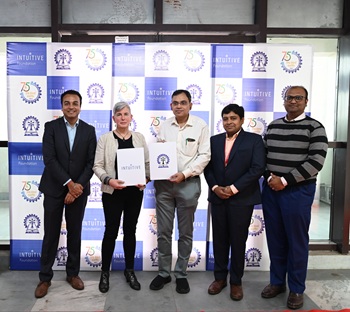
- IIT Kharagpur inaugurates MANAS – Multi-modal AI in Navigation & Automation for Surgical Robotics, in partnership with the Intuitive Foundation.
- The initiative will enable IIT Kharagpur to create structured digital models of surgery that map surgical decisions and help improve the consistency of robotic-assisted procedures
- AI-enabled analysis of real surgical data will help identify key decision points and tasks that may be suited for selective early-stage automation
- The research is powered by Intuitive Foundation’s da Vinci Research Kit (dVRK), a specialised non-clinical platform repurposed from retired da Vinci systems for academic experimentation
Kharagpur : IIT Kharagpur, India’s first and largest IIT, has announced a new research programme in partnership with Intuitive Foundation, a non-profit organisation funded by Intuitive Surgical, a global technology leader in minimally invasive care and the pioneer of robotic-assisted surgery.
The initiative aims to develop comprehensive digital models of surgical care that can underpin more reliable safety guidance, AI-enabled decision support, and responsible early-stage automation in future robotic-assisted procedures. Over time, these advancements are expected to help surgeons work with greater confidence and consistency, supporting better patient outcomes through more standardised and predictable surgical processes.
To test these models, IIT Kharagpur will use the da Vinci Research Kit (dVRK), a non-clinical research platform built from retired da Vinci systems. The dVRK links digital models to physical robotic movements, enabling the development and testing of early automation modules using phantoms, synthetic tissues, and anatomical models. All testing will take place in controlled laboratory settings and will not involve human surgery.
The work is guided by a multidisciplinary research team and supported by IIT Kharagpur’s long-standing collaboration with Nil Ratan Sircar Medical College and Hospital in Kolkata. By closely documenting cholecystectomy procedures (the surgical removal of the gallbladder) in real clinical settings, the researchers will gain practical insight into how surgeries unfold, helping them refine the digital models and identify where supportive tools could have the greatest impact.
Prof. Suman Chakraborty, Director, IIT Kharagpur, said, “This programme reflects the strength of collaboration between academia, clinicians, and global technology partners in addressing complex challenges in surgical care. By working closely with the Intuitive Foundation and our clinical collaborators, we are combining engineering science with real-world surgical expertise to build knowledge that can be shared, validated, and collectively advanced. Such partnerships are crucial to developing robust and responsible frameworks that enhance surgical safety and promote improved outcomes for patients worldwide.”
Prof. Debdoot Sheet, Associate Professor, IIT Kharagpur, added, “Our focus is to document surgery in a form that computational systems can understand. By analysing how surgeons make decisions across the entire surgical journey, we can identify the points where targeted reinforcement or guidance can strengthen safety. These structured models also help us recognise steps that are simpler and highly repeatable, which can be automated reliably in a controlled environment. The purpose is to elevate the surgeon’s focus to complex decision-making, while standardised tasks are executed with uniform precision.” Joining these efforts at IIT Kharagpur are also Prof. Partha Pratim Chakrabarti and Prof. Subhamoy Mandal.
The programme is expected to deliver two major outcomes.
The first is a complete digital footprint of the surgical pathway, enabling AI-driven systems that combine diagnostic details, planned scenarios, intra-operative context, and recovery data to highlight safer techniques, flag deviations, and trace the sources of complications.
The second is the responsible introduction of selective automation. Once the mapped workflows identify steps that are simpler, safer, and more repeatable, targeted automation modules can support surgeons during routine tasks and help them focus on higher-level decision-making.
“The dVRK has become an important resource for academic research, with 40 engineering groups across 41 universities in 11 countries using the platform to explore new questions in surgical robotics,” said Dr. Catherine Mohr, President of the Intuitive Foundation. “By providing a non-clinical system for this work, we enable the next generation of young engineers and designers to test early concepts safely and systematically long before they reach patients. It is encouraging to see teams like IIT Kharagpur investing in the future of India and using the platform to advance rigorous inquiry into the future of robotic-assisted surgery.”
Commenting on the initiative, Rohitt Mahajan, Vice President and General Manager, Intuitive India, “Intuitive is committed to supporting academic research that drives scientific progress in minimally invasive care. Through the dVRK platform, universities can explore new concepts to accelerate the future of robotic-assisted surgery. IIT Kharagpur’s expertise in surgical informatics and robotics makes it a valued collaborator and academic partner, and we are pleased to collaborate with the institute in the efficient translation of research ideas into practical applications. We look forward to supporting the team here in their mission to reduce variability of patient outcomes through standardisation of decision making in surgery by leveraging artificial intelligence and machine learning”.
This programme reflects India’s growing capability to contribute to global thinking on surgical safety, digital documentation, and responsible automation. By bringing together clinical insight, computational modelling, and rigorous experimental testing, IIT Kharagpur aims to help define the scientific principles that will guide the future of robotic-assisted surgery.



Leave a Reply