
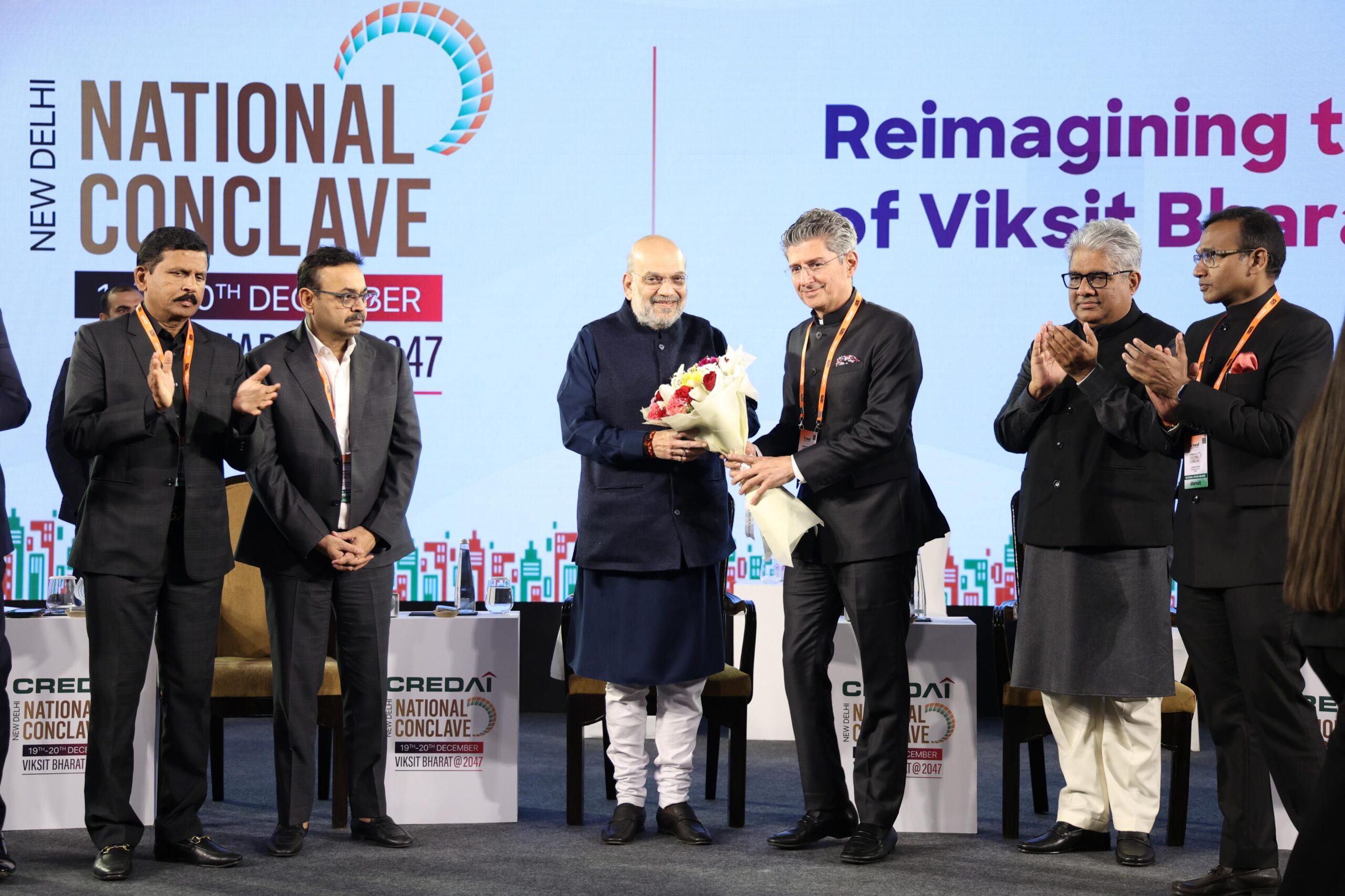
- Hon’ble Home Minister, along with Union Ministers, Chief Ministers, and other senior officials, engaged with the industry on urban development and housing
- CREDAI announced strategic MoUs to advance technology-led infrastructure and sustainable real estate practices
- The day concluded with the CREDAI Awards for Real Estate Excellence, celebrating outstanding leadership, innovation, and sustainability in the sector.
Mumbai : The CREDAI National Conclave commenced today, bringing together senior policymakers, state government representatives, and industry leaders to deliberate on real estate’s transformative role in India’s urban development and economic growth. The Conclave highlighted the sector’s pivotal role in building sustainable and inclusive cities and advancing India’s vision of Viksit Bharat @2047.
The inaugural session was graced by Shri Amit Shah, Hon’ble Home Minister and Minister of Cooperation, Government of India, along with Union Ministers, Chief Minister, and senior officials from the Central and State Governments. On the occasion Hon’ble Home Minister launched CREDAI’s Ecological Reforestation and Restoration initiative, under which reforestation will be undertaken across 9,000 acres spanning over 25 villages in the Western Ghats (Sahyadri Hills) of Nashik district, Maharashtra
In his address Shri Amit Shah, Hon’ble Home Minister and Minister of Cooperation, Government of India said, “Real estate is a key pillar of India’s urban transformation and economic growth. Over the last decade, the Government has strengthened urban and infrastructure development through clear policy frameworks, regulatory reforms, and long-term planning aligned with the vision of Viksit Bharat @2047. I commend CREDAI for its leadership in responsible development, including its ecological restoration initiative covering 9,000 acres. Developers must integrate afforestation, sustainability, skill development, and affordable housing into every project, as India moves towards world-class, inclusive, and environmentally responsible urban growth.”
Shri Bhupender Yadav, Hon’ble Minister for Environment, Forest and Climate Change, Government of India said, “I commend CREDAI for its meaningful CSR initiatives and its strong commitment to environmental stewardship. Real estate plays a critical role in advancing employment, social mobility, and quality of life through housing, commercial infrastructure, logistics parks, and urban renewal. Under the Hon’ble Prime Minister’s vision of Viksit Bharat @2047, development and environmental protection must progress together. With streamlined environmental clearances, a focus on energy efficiency, water conservation, waste management, renewable energy, and climate-resilient planning, the sector can lead India towards future-ready, sustainable urban development.”
Shri N. Chandrababu Naidu, Hon’ble Chief Minister of Andhra Pradesh, speaking at the CREDAI National Conclave 2025, said “The decision to bring the Indian School of Business to India and establish it in Hyderabad was driven by an enabling policy environment, ease of doing business, and a responsive administrative system that worked closely with stakeholders. Platforms such as the CREDAI National Conclave play a vital role in fostering collaboration between government and industry. I invite developers and institutions to explore opportunities in Andhra Pradesh, where we are committed to providing land, facilitative programmes, and supportive policies to enable sustainable, transparent, and inclusive urban development.”
The opening day of the Conclave focused on advancing India’s urban development through housing, innovation, and collaborative governance. Hon’ble Chief Minister of Gujarat Shri Bhupendra Patel shared insights on state-level development priorities and governance reforms. Senior officials from the Ministry of Housing and Urban Affairs engaged with CREDAI leadership on policy enablement and shaping the future of urban infrastructure.
Mr. Shekhar Patel, President, CREDAI, said, “The CREDAI National Conclave is an important forum to bridge policy intent with industry action. Our discussions with senior ministers and state leaders highlight the critical need for regulatory clarity, sustainable urban planning, and technology-driven development. By signing strategic MoUs with Goa-IDC and IIHS, we are translating dialogue into tangible initiatives that drive innovation, foster investment, and promote responsible growth across India’s real estate sector. CREDAI is committed to ensuring that development is not just rapid, but smart, inclusive, and sustainable.”
As part of these strategic collaborations, CREDAI announced:
- Memorandum of Understanding with the Goa Industrial Development Corporation (Goa-IDC): Establishing a knowledge partnership for the proposed Hello World Innovation & Research Park at the Verna Industrial Estate in Goa. The initiative will support an integrated technology campus comprising IT/ITeS enterprises, Global Capability Centres, data centres, and research and development facilities, with a strong focus on sustainable planning and employment generation.
- Memorandum of Understanding with the Indian Institute for Human Settlements (IIHS): Strengthening applied research, advisory services, and capacity-building initiatives. The partnership will advance high-performance buildings through the ASSURE Programme—covering both greenfield and brownfield projects—and promote evidence-based approaches to sustainable urban development.
Around 600 delegates from across India attended the inaugural day of the CREDAI National Conclave, which concluded on a high note with the CREDAI Awards for Real Estate Excellence. The awards recognised outstanding achievement, innovation, and leadership across the sector.
The awards recognised developers and projects that excelled in execution, sustainability, community impact, and adoption of innovative practices, setting benchmarks for quality and responsible growth in Indian real estate. By showcasing exemplary projects, the CREDAI Awards aim to inspire the industry to embrace best practices, foster technological adoption, and contribute to inclusive and sustainable urban development nationwide.



Leave a Reply