
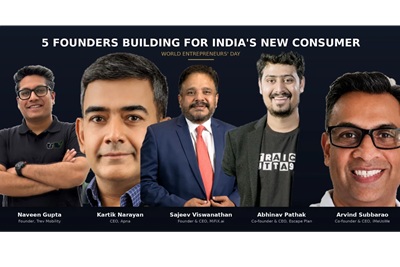
As India’s entrepreneurial landscape matures, the opportunity for founders is no longer limited to creating entirely new categories. Increasingly, entrepreneurs are identifying gaps within established markets and building businesses around changing consumer behaviour, technology and evolving expectations.
On World Entrepreneurs’ Day, here are five founders building businesses across mobility, fintech, travel, employment and family heritage.
Naveen Gupta, founder, Trev Mobility: Building reliability into premium electric mobility
Naveen Gupta’s entrepreneurial journey is backed by experience across some of India’s most recognisable mobility and consumer businesses, including Hero MotoCorp, redBus, Swiggy, Cars24 and Zoomcar. He founded Trev Mobility with a focus on premium, all-electric mobility, particularly airport transfers, rentals and outstation travel.
The company has been scaling its presence across Delhi-NCR and has completed more than 50,000 rides, with more than 90 premium electric SUVs and around 55% of revenue coming from repeat users, according to Gupta. In April 2026, Trev raised ₹3.65 crore in its maiden funding round from 11 angel investors, several of whom had first experienced the service as customers.
For Gupta, the opportunity goes beyond putting more EVs on the road. Trev is betting on consistency, professional chauffeurs and a more dependable premium experience at a time when the EV mobility sector is being reshaped.
Kartik Narayan, CEO, Apna: Building the infrastructure for India’s workforce
Kartik Narayan took over as CEO of Apna in 2025, bringing with him experience as the former CEO of TeamLease Staffing.
At Apna, his focus is on one of India’s biggest structural opportunities: connecting employers and workers at scale. In a recent discussion at the BusinessLine MSME Growth Conclave, Narayan highlighted the sheer scale of India’s working-age population and argued that employment infrastructure needs to be built for that scale. He also emphasised that workforce retention is increasingly about employee experience and that AI can act as an equaliser rather than simply a replacement for workers.
His entrepreneurial story sits at the intersection of technology, employment and India’s changing labour market, where the challenge is no longer simply creating jobs, but creating more efficient ways to connect the right people with the right opportunities.
Sajeev Viswanathan, founder and CEO, New Street Technologies: Building the AI infrastructure for financial services
Sajeev Viswanathan is the Founder and CEO of New Street Technologies, the technology company behind MiFiX.ai, an AI-native enterprise platform designed for regulated industries and financial services.
Viswanathan’s focus is on a less visible but critical part of India’s digital transformation: the technology infrastructure that enables financial institutions to build, adapt and deploy enterprise systems faster. MiFiX.ai is designed to help organisations move from business requirements to deployable enterprise systems through AI-driven configuration, while maintaining the governance, security and controls expected in regulated environments.
His entrepreneurial journey reflects the next phase of India’s fintech story, where the opportunity is moving beyond consumer-facing applications towards the underlying technology that can make banks and financial institutions more agile. Viswanathan has also been vocal about the need for enterprises to approach AI not simply as a technology upgrade, but as a fundamental shift in how businesses operate.
Abhinav Pathak, Co-founder and CEO, Escape Plan: Reimagining the travel category as a platform
Abhinav Pathak is building Escape Plan around a simple observation: travel has become a much bigger part of everyday lifestyle, but the products and retail experience around it have not evolved at the same pace.
A second-time entrepreneur after founding Perpule, which was acquired by Amazon in 2021, Pathak co-founded Escape Plan with Abhinav Zutshi in 2025. The company initially raised $5 million in seed funding from Jungle Ventures and Fireside Ventures and set out to build a multi-brand travel platform spanning luggage, backpacks, accessories and other travel needs.
The business has since moved rapidly. In January 2026, Escape Plan raised a further $25 million Series A led by Jungle Ventures, with IndiGo Ventures participating as a strategic investor. The company is using the capital to accelerate offline retail, strengthen its supply chain and pricing capabilities, expand into adjacent travel categories and reach a wider consumer base.
Pathak’s journey is a reminder that entrepreneurship can also mean taking a familiar category and rebuilding the way consumers experience it.
Arvind Subbarao, Co-founder and CEO, iMeUsWe: Astrology Guided by Your Family History
Arvind Subbarao is building a platform around a distinctive idea: Astrology Guided by Your Family History. iMeUsWe combines Vedic astrology with family history to provide personalised guidance, bringing together an individual’s birth chart, life journey, family patterns and cultural heritage to provide greater context for life’s decisions. Rather than positioning astrology purely as prediction, the platform aims to make it a more contextual and personalised form of guidance.
The platform’s personal guidance companion, Anvaya, builds on previous conversations, life events and family context to make its guidance increasingly personal over time. This creates an ongoing experience rather than a one-time astrological reading, allowing the guidance to evolve alongside an individual’s life and circumstances.
For Subbarao, this represents a broader opportunity to bring technology into deeply personal areas of life. By connecting Vedic astrology with family history and lived experiences, iMeUsWe aims to help individuals understand their present choices through the lens of both their personal journey and the family patterns and heritage that shape them.
The larger entrepreneurial opportunity
What connects these founders is not the sectors they operate in, but the problems they have chosen to solve. From making urban mobility more dependable and employment more scalable to rethinking travel, financial technology and family heritage, their businesses reflect a broader shift in Indian entrepreneurship.
The next generation of Indian founders may not always create entirely new markets. Increasingly, they are looking at familiar markets through a new lens and building the infrastructure, experiences and platforms that those markets need next.




Leave a Reply