
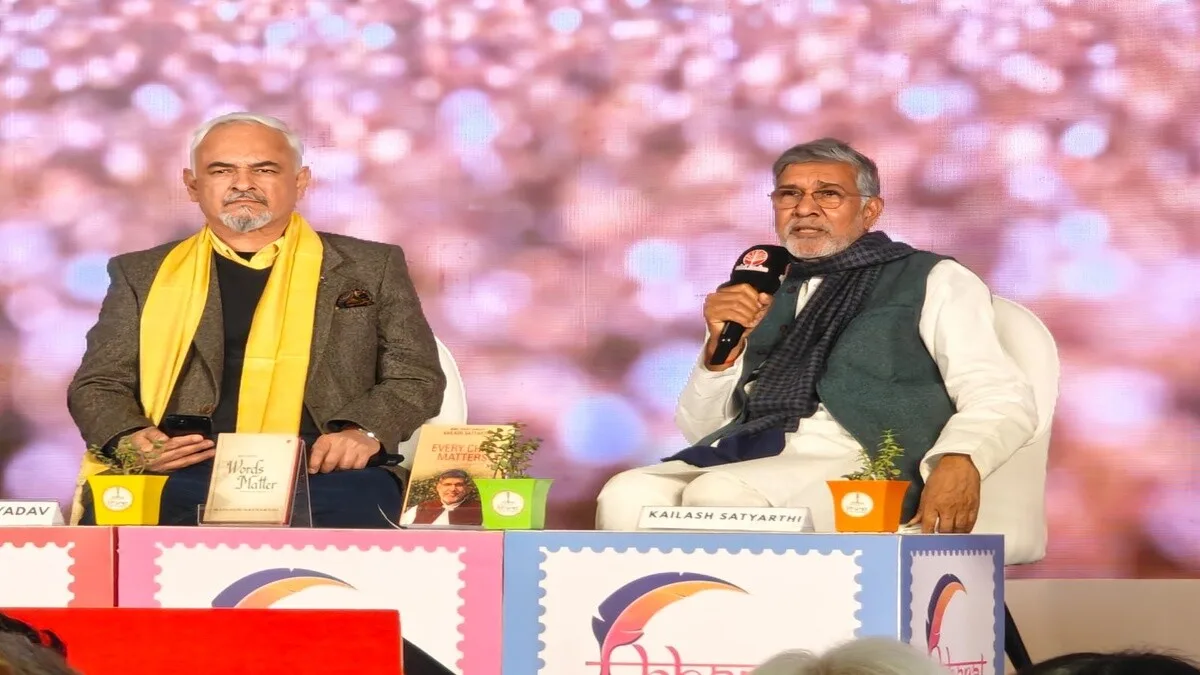
At the New Delhi World Book Fair 2026, Satyarthi urged integrating the compassion quotient (CQ) into education, workplaces, leadership and even marriage, arguing that empathy is as crucial as intelligence.
New Delhi : Nobel Peace Prize laureate Kailash Satyarthi on Wednesday called for greater emphasis on what he described as the “compassion quotient” in public life, education and workplaces, arguing that empathy must be valued as highly as intelligence in shaping a humane society.
Addressing children and visitors on the fifth day of the World Book Fair, Satyarthi said people respond to social problems in very different ways. “For some, it is merely a task. For others, it becomes a deep personal commitment. I call this level of involvement a compassion quotient, or CQ,” he said. Drawing a parallel with IQ, he added that CQ could serve as a meaningful parameter to assess how deeply individuals care about the lives and struggles of others.
The Nobel laureate was speaking in the context of his forthcoming book, Karuna: The Power of Compassion, which was introduced to readers at the fair. Visitors were handed booklets outlining the book’s central ideas, and the session drew a large audience, particularly young readers and students.
Satyarthi suggested that society may soon place greater value on compassion in personal and professional decision-making. “In a few years, our youth may stop asking for kundalis for marriage and instead want to know the CQ of their prospective partner—to see whether they can adjust, empathise and grow together as a family,” he said. He also urged corporate India to consider compassion while appointing senior leaders, arguing that empathy-driven leadership leads to more ethical and sustainable institutions.
During the interaction, Satyarthi shared personal experiences from his life and from his autobiography Diyaslai. Recalling an incident from his early years as a social activist, he spoke about learning of a temple that barred entry to people from lower castes, with a stone outside declaring the restriction. “The moment I heard about it, I knew I had to intervene,” he said.
The attempt to challenge the discrimination, he recalled, was met with fierce resistance. “Upper-caste groups opposed us violently. Many of our people ran away, fearing for their lives,” he said. It was at that moment, Satyarthi added, that leadership demanded personal courage. He stayed put, worked with the police to trace his colleagues, and ensured the issue received national attention. “The matter reached the highest levels. The President of India took cognisance and announced a visit. Eventually, after decades, that stone was removed,” he said.


Leave a Reply