
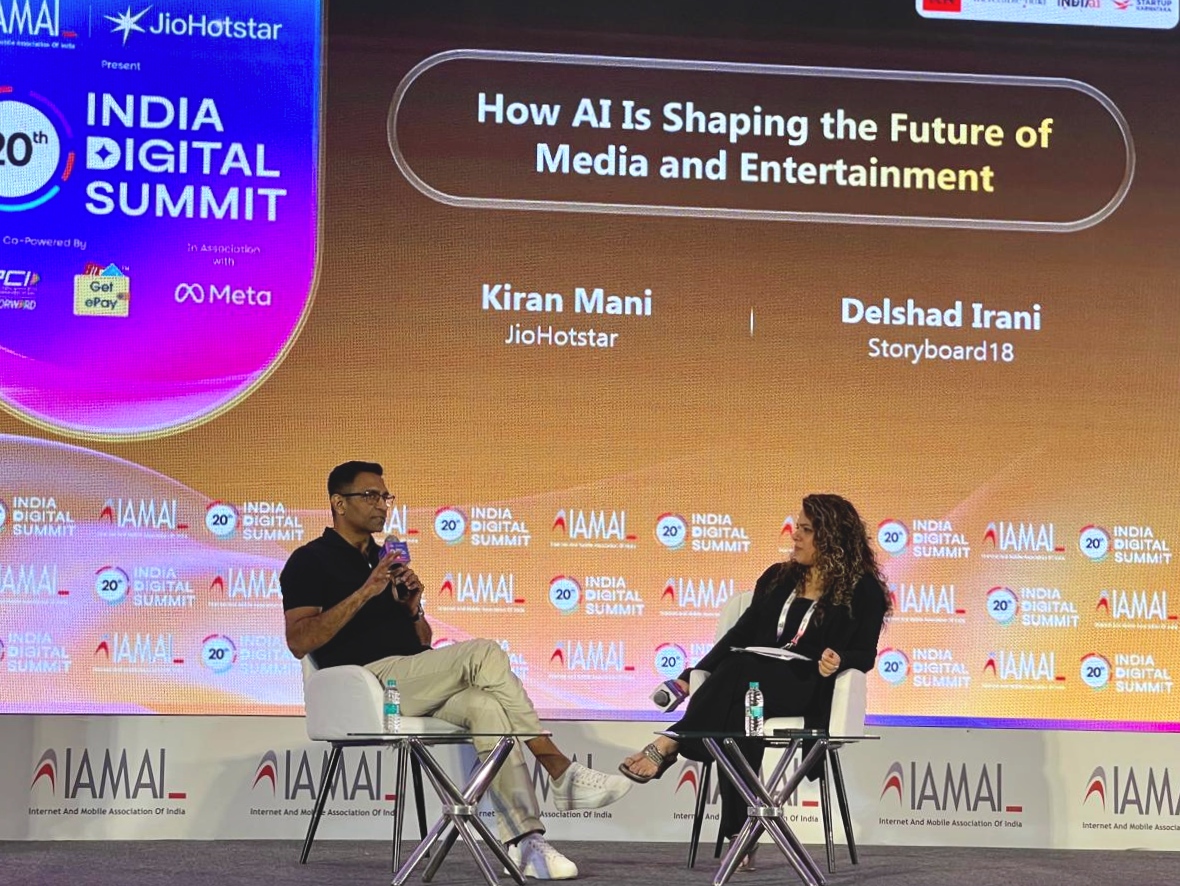
Bengaluru : Artificial intelligence is quietly but fundamentally changing the way people discover, watch and engage with content, according to Kiran Mani, CEO – Digital, JioStar who spoke at the Indian Digital Summit 2026 organised by IAMAI in Bengaluru on Thursday.
In a session moderated by Delshad Irani, Mani said the current AI moment feels similar to the shift from BlackBerry phones to smartphones, when technology stopped being about buttons and instructions and started becoming intuitive. He noted that AI is now doing something similar to content by making experiences simpler, faster and far more natural for consumers.
For Mani, the biggest change is happening at the consumer level. AI is reducing the effort it takes to find something to watch by understanding behaviour in real time. Instead of relying on age, location or past viewing history, platforms are increasingly responding to what viewers are doing in the moment, whether it is pausing, skipping, searching or asking questions. This is helping cut down the long browsing cycles that many viewers experience before settling on a piece of content.
This shift is also making second-screen behaviour feel seamless rather than distracting. Viewers can explore actors, characters, match statistics or key moments without stepping away from what they are watching, turning curiosity into a natural part of the viewing experience.
India’s unique media landscape adds another layer to this transition. Mani pointed out that AI in India has to work across a wide range of devices and access levels, from connected TVs in urban homes to low-cost smartphones in smaller towns. According to him, the real challenge is not building sophisticated AI for a few users, but making intelligence work at scale, across millions of screens.
On content creation, Mani said AI is lowering barriers that have traditionally held back new storytellers. Stories that once required large budgets can now be visualised and produced far more efficiently, allowing creators to focus on ideas rather than constraints. He added that the distinction between premium and short-format content is beginning to blur, with strong storytelling finding its audience regardless of length.
“Good stories don’t need to be long to be impactful. A short format can be just as powerful if the idea connects,” Mani said.
Addressing concerns around AI replacing jobs and creativity, Mani emphasised that AI is driving a natural evolution of roles rather than eliminating them. By taking over repetitive and execution-heavy tasks, AI is enabling people to focus on higher-value, more meaningful creative work. He noted that some of the most exciting progress is emerging where creative teams and technologists work closely together, unlocking new possibilities for storytelling.
From a platform perspective, Mani said the focus is shifting from simply being available everywhere to becoming smarter everywhere. Once infrastructure is in place, intelligence allows platforms to better understand viewer intent and respond to it across screens. Content is now being analysed in real time, making it possible to surface relevant information, highlights and interactions while the viewer is still engaged.
Interactivity is becoming an important part of this evolution. Features such as voting, meme creation and interactive tools are encouraging audiences to participate rather than just watch. Mani noted that when given the opportunity, viewers often find creative ways to engage with content that platforms themselves may not anticipate.
He also spoke about how personalisation is evolving. Instead of placing users into fixed categories, AI is learning from moment-to-moment behaviour, making recommendations feel more relevant and less repetitive. This shift, he said, is making content discovery faster and more aligned with individual preferences.
Looking ahead, Mani sees conversational AI and voice as key areas of growth. True conversational experiences go beyond voice search and allow users to interact with content in a more natural, dialogue-driven way. As voice, text and video come together, media experiences are expected to become more immersive and personal.
Ultimately, Mani said success in the AI era will be defined by real impact rather than just technology adoption. “If we can turn every screen into a meaningful interaction and help creators build more sustainable careers, we would have genuinely moved the industry forward,” he said.





Leave a Reply