
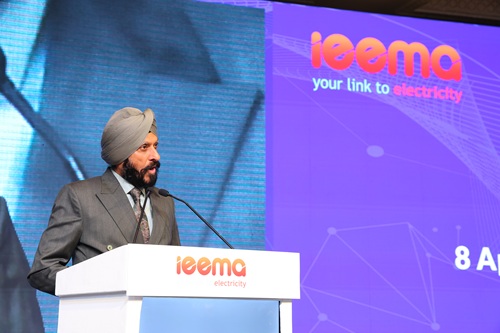
- Incoming ELECRAMA Chairman underscores need for grid expansion, smart infrastructure, and domestic manufacturing scale-up
- Smart grids, AI-led automation, and transmission investments to address renewable curtailment and infrastructure gaps
- MSME ecosystem and policy responsiveness seen as critical enablers of India’s energy transition
Mumbai: Electrification is emerging as the central pillar of India’s energy security strategy, particularly in an increasingly volatile global environment, Mr. Hartek Singh, CMD, Hartek Power, said as he assumes leadership as Chairman for ELECRAMA 2027.
At a time when geopolitical tensions, including those in West Asia, continue to expose the fragility of global energy supply chains, Mr. Singh emphasised that India’s response must be anchored in strengthening domestic capability, accelerating electrification, and building resilient infrastructure.
“Energy security cannot be outsourced. Electrification, supported by grid expansion and digital intelligence, will define India’s pathway to resilience and long-term growth,” he said.
He noted that India’s renewable energy ambitions, targeting 500 GW capacity, must be complemented by proportional investments in transmission infrastructure and smart grid systems. While renewable capacity can be deployed rapidly, transmission networks require longer gestation, leading to interim challenges such as curtailment in key states. However, ongoing investments in grid expansion and the integration of AI-led monitoring and automation are expected to progressively address these constraints.
Mr. Singh further highlighted the structural strength of India’s MSME ecosystem, which constitutes a significant share of the electrical manufacturing value chain. Enhancing quality standards and making these enterprises globally competitive will be critical to positioning India as a global manufacturing hub for power equipment.
He also pointed to the increasingly responsive policy environment, where close coordination between industry and government is accelerating execution and addressing sectoral bottlenecks, including input cost pressures and project timelines.
The next phase of India’s energy transition, he said, will be defined by the adoption of smart grids, integrating automation, artificial intelligence, and advanced analytics to enable efficient load management and reliable power delivery.
In this context, the Government of India has reinforced electrification as central to energy security. In his March 23, 2026 address, the Prime Minister emphasised reducing hydrocarbon dependence through electrified systems to build resilience. India’s capacity stands at ~520 GW, including ~283 GW non-fossil; the nation has a 500 GW renewable energy capacity target by 2030.
This is backed by ~₹3 lakh crore under RDSS and a ₹6 lakh crore-plus transmission pipeline, signaling a decisive shift to an electricity-led economy.
The Indian Electrical & Electronics Manufacturers’ Association (IEEMA) has launched the 17th edition of ELECRAMA 2027, scheduled from February 20–24, 2027 at India Expo Mart, Greater Noida.
The event is expected to host over 1,100 exhibitors and generate business enquiries worth approximately USD 25 billion.
Under Mr. Singh’s leadership, ELECRAMA 2027 will focus on global collaboration, advanced manufacturing, and digital innovation, reinforcing India’s ambition to emerge as a global hub for electrical equipment and energy solutions.
As India navigates a complex global energy landscape, electrification is a strategic imperative shaping the country’s economic and industrial future.


Leave a Reply