
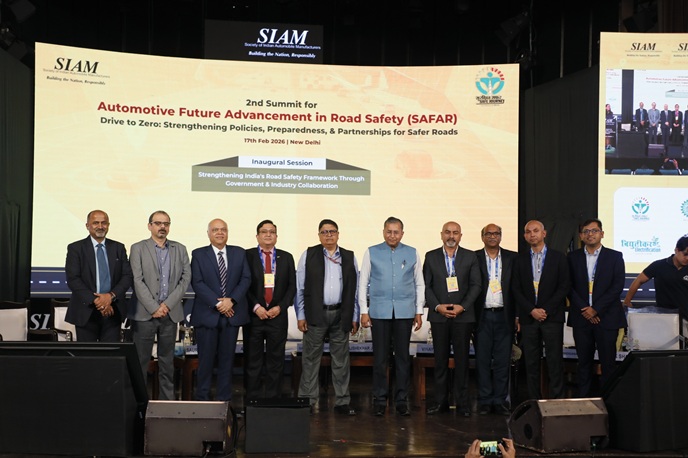
Mumbai, Bangalore : Setting off a thundering call to reduce road fatalities on our roads, the Society of Indian Automobile Manufacturers (SIAM) hosted the 2nd Summit on Automotive Future Advancement in Road Safety (SAFAR) today, with the theme: ‘Drive to Zero: Strengthening Policies, Preparedness, and Partnerships’. As part of SIAM Sustainable Mobility Week 2026, the summit focused on strengthening road safety policies, improving preparedness, fostering partnerships, and enhancing post-crash response systems in line with national and global targets.
The four-day initiative, being held from February 16 to 19, serves as a unified platform bringing together stakeholders, visionary policymakers, industry leaders, emergency care experts, Original Equipment Manufacturers (OEMs), Non Governmental Organisations (NGOs), and civil society leaders to discuss key sustainability priorities including decarbonisation, road safety, post-crash care, circularity, material compliance and collaborations.
Running alongside the conference sessions, SIAM’s Sustainable Mobility Zone continues to draw attention as a live technology showcase featuring next-generation vehicle platforms, advanced safety systems, alternative fuel solutions and enabling infrastructure. The exhibition, open to participants and visitors, presents real-world demonstrations of industry-led innovations designed to make mobility cleaner, safer and more efficient.
The inaugural session, “Strengthening India’s Road Safety Framework Through Government & Industry Collaboration”, showcased deep dives into policy and industry synergies to enhance road safety. The session was graced by the presence of Chief Guest Dr. Rajshekhar Joshi, Vice Chairman, Sethu Aayog, and Guest of Honour Mr. Sanjay Bandopadhyaya, Member, Supreme Court Committee on Road Safety, along with leading industry figures and experts.
Welcoming the dignitaries, Mr. Prashant K Banerjee, Executive Director, SIAM, said, “India takes pride in being the third-largest automobile industry in the world, a growth that brings with it the responsibility of road safety. It is essential for students and young citizens to take up this challenge and play an active role in building safer and more stable roads for the future. ‘Sadak Suraksha’ and ‘Jeevan Raksha’ have become paramount, and initiatives such as SIAM’s ‘Surakshit Safar’ reflect how collective efforts can address the road safety challenges our country faces.”
While addressing the summit, Chief Guest Dr. Rajshekhar Joshi, Vice Chairman, Sethu Aayog, Uttarakhand, said, “We need a mission-oriented approach to education that addresses not only the social but also the economic impact of road safety, as safer vehicles and safer roads reinforce each other. AI can help identify black spots and strengthen response systems, while effective awareness campaigns on social media can further enhance road safety reforms.”
Guest of Honour Mr. Sanjay Bandopadhyaya, Member, Supreme Court Committee on Road Safety, remarked, “We seek regular reports from states and hold them accountable for victims and their families, as enforcement is a critical component of road safety. Police, health, transport and insurance authorities must work together to strengthen implementation. The Government of India’s zero-fatality programme across 100 districts and financial support for victims, along with the integration of AI-based safety measures, can significantly improve outcomes.”
While giving the opening address, Mr. Alok Jaitley, President SAFE & Ex VP, Maruti Suzuki India Ltd., stated, “Every day millions step onto the roads hoping to return home safely, yet many do not, and every life lost is a loss to the nation. India records nearly 4.8 lakh accidents annually, reflecting system gaps. Road safety must be a shared responsibility, supported by stronger policy, preparedness and partnerships, better behaviour, faster response and proper use of technology.”
Mr. Vinay Dhingra, Sr Director, Honda Motorcycle and Scooters (I) Ltd., said, “Road safety is a vital pillar of Viksit Bharat and a national development imperative. Basic behavioural issues like not wearing helmets and seat belts must be addressed. While safer vehicles are being enabled, they cannot compensate for dangerous roads or unsafe behaviour, which is why stronger, technology-driven licensing systems are essential.”
Mr. Chalumuri Ravi Shekhar, Director, CRRI, remarked, “AI-powered road safety initiatives like iRASTE in Telangana aim to cut road crashes and fatalities by 50% through a focused approach combining infrastructure safety, mobility analysis and vehicle safety. Technologies such as ADAS and Driver Monitoring Systems can detect risks early and help prevent accidents, making roads significantly safer.”
Dr. Manish Jaiswal, Director, NATREX, said, “Around 10–12% of accidents in India are linked to road infrastructure, making safety infrastructure equally important. Features such as crash-barrier testing on highways can strengthen protection, especially for heavy vehicles, and stronger policies are needed to mandate them. We must evolve our framework for next-generation highways and city planning to ensure better traffic management and integration of intelligent systems.”
Mr. Saurabh Dalela, Director, ICAT, added, “In India, rear seat-belt usage remains low, and nearly 70% of road accidents involve two-wheelers. Clear SOPs for post-accident response and stronger institutional coordination are essential, as collaboration is the only way forward.”
This was followed by a thematic presentation by Mr. Pratik Sha, Partner, E & Y Parthenon on “Strengthening India’s Road Safety Framework through Government and Industry Collaboration”. The session concluded with closing remarks by Mr. Bhagwan Bindiganavile, Treasurer SAFE & Executive Vice President-Strategic Planning, Brand and Communication, VE Commercial Vehicles, by adding, “Helmets, ADAS and passenger safety systems are critical, but behaviour ultimately determines their effectiveness. Road fatalities impact families and lead to significant loss of productivity, making this a collective moral responsibility. Even the most advanced solutions cannot succeed without collaboration. Our focus must be on what truly saves lives, and with opportunities such as AI, we can strengthen efforts toward the ultimate goal of zero fatalities.”
During the summit, SIAM has also launched the Context Paper on “Advancing Road Safety Through Systemic Policy Reform”.
The Technical Session on “Innovation in Vehicular Safety Technology” was moderated by Mr. Deepanshu Taumar, Editor, ET Auto. It featured presentations by Mr. Kulbhushan Kumar, Partner, GT, on Need for a Connected Safety Chain; Mr. Alexander Zink, Chief Business Development Manager, Digital Radio, Fraunhofer, on Digital Radio Innovations (DRM); Mr. Gururaj Ravi, Vice President Global Regulatory Affairs & Policy, Maruti Suzuki India Ltd. on continuos improvements on vehicular safety; Mr. S Ramanathan, MD, Automotive Test Systems, on ADAS; Mr. Pranjal Nadhani, Co-Founder & CTO, Cautio, on cautionary technologies; Dr. Jayant Ratti, Founder & CEO, Nayan Tech, on vision-based safety tech; Mr. Hutesh Kumar Gautam, Founder, Drivomate Technologies, on driver assistance, and Mr. Arbab Ahmad, Partner, Studio Urbanlinq LLP, on Road Safety & Mobility Patterns.
The “Workshop on Saving Lives Post Crashes” focused on post-crash response and life-saving skills, including a presentation by Captain Sandhya Shanker Pandey, Corporate Chief of Nursing, Fortis, on how the medical trauma team is forced into damange control instead of early care.
The final Panel Discussion, moderated by Mr. Sumit Chaturvedi, Founder and Editor in Chief, VoiWorld.com, centered on shared education, shared data, community-focused vehicle technology, and future-ready partnership models.
Panellists included Mr. Prabhu Nagraj, Head Operating Officer, Honda Motorcycle and Scooters India Ltd.; Ms. Latika Taneja, Head of Corporate Communications, Corp Affairs and CSR, Hero MotoCorp Ltd.; Mr. Saurabh Verma, Co-Founder, Synergie; Ms. Rajni Gandhi, Founder & General Secretary, TRAX; Mr. Deepak Sharma, Founder, Mayank Foundation; and Prof. (Dr) Prerana Arora Singh, Managing Director- Asian Road Safety Academy, India & Director, Centre for Road Safety Management, Nirwan University, Jaipur.
As part of the ongoing Sustainable Mobility Week, SIAM will host the 4th International Conference on Sustainable Circularity (ICSC) on 18 February 2026, continuing the dialogue on sustainability across the mobility ecosystem. The four-day initiative will conclude on 19 February 2026 with the 1st International Conference on Automotive Material Compliance & Sustainability (AMCS) which will further advance discussions on responsible manufacturing, compliance and future-ready mobility solutions.
Over the years, SIAM has consistently collaborated with governments, industry leaders, corporations, and key stakeholders to champion the transition to cleaner fuels and cutting-edge technologies. These purposeful engagements reflect SIAM’s core mission of ‘Building the Nation Responsibly’ while advancing sustainable mobility and contributing meaningfully to India’s Sustainable Development Goals by 2030.

Leave a Reply