
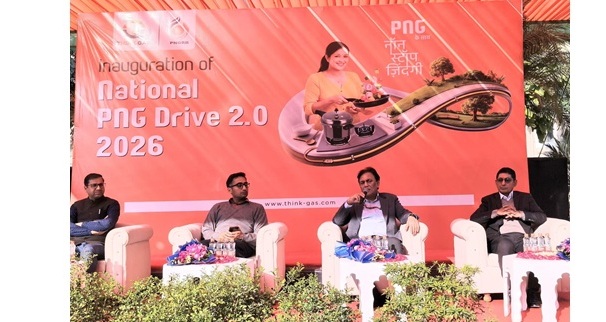
~ Through this campaign, THINK Gas aims to connect 30000+ Households with PNG connections and expand CNG station network across 10 states ~
National : Strengthening India’s transition towards a gas-based economy, THINK Gas, one of India’s leading City Gas Distribution (CGD) companies, today kicked off the implementation of the Petroleum and Natural Gas Regulatory Board’s (PNGRB) National Drive 2.0 with an inaugural event at Jodhpur. The campaign was inaugurated by Dr. Anil Kumar Jain, IAS, Chairperson – PNGRB, in the presence of Mr. Amitava Sengupta, Chairman. The nationwide campaign advances the vision of “One Nation, One Grid, One Tariff” by expanding PNG access and accelerating CNG adoption across India.
As part of this campaign, THINK Gas also announced its commitment to connect 30000+ households with PNG connections and enhance the CNG station network across 10 states. During the inaugural event, THINK Gas commenced the operations of PNG Connection to 500 households in Ashiana Dwarka – Premium Homes and flagged off a CNG rally to signify the strengthening of CNG adoption in the region.
Speaking on the occasion, Dr Anil Kumar Jain, Chairperson, Petroleum and Natural Gas Regulatory Board (PNGRB), said “National Drive 2.0 is a focused initiative of PNGRB to deepen the reach of City Gas Distribution networks and accelerate the adoption of PNG and CNG across the country. The Unified Tariff framework is enhancing affordability, transparency, and access, ensuring that regulatory reforms translate into direct consumer benefits. THINK Gas has exemplified this vision by investing over ₹510 crore in the Barmer–Jodhpur–Jaisalmer Geographical Area and adopting a unique LCNG-based hybrid supply model to ensure uninterrupted gas supply even in the absence of pipeline connectivity. With nearly 60% of Jodhpur city covered, over 51,000 households connected, and domestic PNG prices reduced by ₹2.77 per SCM from January 1, 2026, the impact at the household level is clearly visible. Such LNG-based CGD models are replicable for expanding clean, reliable, and economical energy to far-flung areas. I am confident that National Drive 2.0 will significantly accelerate PNG and CNG adoption nationwide and strengthen India’s clean energy ecosystem.”
Commenting on the initiative, Mr. Amitava Sengupta, Chairman, THINK Gas, said “PNGRB’s National Drive 2.0 is a landmark initiative that will play a pivotal role in accelerating the adoption of PNG and CNG across India. This drive comes close on the heels of the implementation of landmark tariff reforms by the PNGRB when Domestic PNG and CNG segments will benefit from a preferential tariff system. We thank Dr. Anil Kumar Jain, Chairperson, PNGRB, and the Board for their leadership in creating a progressive regulatory framework, that enables wider access to clean and affordable natural gas. The strong response to last year’s National Drive, which saw significant on-ground enrolments and increased CNG adoption, clearly demonstrated the impact of focused outreach. Building on this momentum, THINK Gas will intensify customer engagement across its licensed Geographical Areas to further scale PNG and CNG adoption and support India’s transition towards a gas-based economy.”
As part of THINK Gas’s active participation in National Drive 2.0, the campaign will be rolled out from January to March 2026 across the 10 states where THINK Gas has presence—Tamil Nadu, Kerala, Andhra Pradesh, Karnataka, Uttar Pradesh, Rajasthan, Bihar, Punjab, Madhya Pradesh and Himachal Pradesh.
Aligning with PNGRB’s Unified Tariff revision, THINK Gas has also announced significant reduction in prices across its operating Geographical Areas which will benefit the end consumer. Under the revised framework, domestic PNG prices have been reduced by up to ₹5/SCM (standard cubic meter) , while CNG prices have been reduced up to ₹2.50/KG in select Geographical Areas. Additionally, THINK Gas has reduced Domestic PNG prices by up to ₹4/SCM in Andhra Pradesh and Tamil Nadu, and by up to ₹2.77/SCM in Rajasthan, even though these states are not yet connected to the National Gas Grid and are not benefiting from the tariff reforms at present.
The multitude of customer centric reforms and initiatives of the PNGRB are expected to result in a significant increase in the adoption of DPNG and CNG in the country.



Leave a Reply