
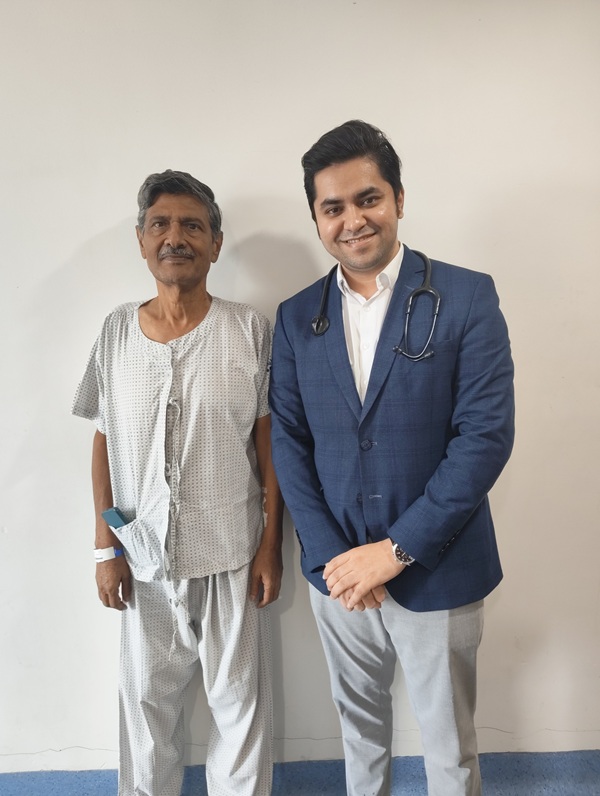
~ Patient with severe multi-vessel coronary artery disease and critically low heart pumping function treated with Intra-Aortic Balloon Pump (IABP)-assisted PCI by Dr. Amit Singh, Consultant Cardiologist
~ Ultra-low contrast strategy used to protect kidneys during procedure; patient discharged within days
Navi Mumbai : Kokilaben Dhirubhai Ambani Hospital, Navi Mumbai, has successfully performed a complex, high-risk coronary angioplasty on a 60-year-old gentleman from Bihar who suffered a major heart attack and presented with severely reduced heart function, with an ejection fraction (EF) of around 20%. In healthy adults, EF is typically in the 55% to 70% range, and significantly lower values can indicate serious damage to the heart’s pumping ability.
Initial investigations in his hometown had shown extensive coronary artery disease with two major coronary arteries having long, critical blockages and the third artery being 100% blocked. This usually requires bypass surgery, which given the patient’s fragile condition and a cardiac MRI revealing a heart functioning at barely one-third of normal capacity was deemed to be extremely high risk. The patient was then evaluated at Kokilaben Dhirubhai Ambani Hospital, Navi Mumbai by Dr. Amit Singh, Consultant Cardiologist with extensive experience in the treatment of Heart Failure.
Dr. Amit Singh, Consultant Cardiologist, Kokilaben Dhirubhai Ambani Hospital, Navi Mumbai said, “The patient had come to us with great hope after his condition was deemed too high-risk for a bypass. After detailed assessment and risk planning, we decided to go in for a complex percutaneous coronary intervention (PCI) supported by mechanical circulatory support using an Intra-Aortic Balloon Pump (IABP). The IABP is designed to inflate during diastole when heart muscle relaxes and the heart fills with blood; and deflate just before systole when the heart contracts and pumps blood out into the body. This helps to improve coronary blood flow while reducing the workload on the heart. This is a critical support during high-risk interventions when blood pressure becomes unstable.”
The patient was admitted a day in advance for haemodynamic optimisation to ensure optimal oxygen delivery to tissues, stabilisation of blood pressure. Breathlessness was managed by reducing the fluid overload due to heart failure. On the day of the intervention, an Intra-Aortic Balloon Pump (IABP) was inserted via an arterial access route to provide circulatory support during the angioplasty.
Medication in form of infusions helped to maintain perfusion pressure, reduce cardiac stress, and support organ function through the procedure. Given the patient’s critical condition, there was a very high risk of contrast-induced acute kidney injury. Hence, a contrast-sparing approach with an ultra-low contrast PCI strategy was used to minimise dye exposure during the angioplasty.
The long blockages were addressed and the completely blocked artery was revascularized by placing a stent placement as clinically indicated. During the procedure, the patient experienced critical episodes of hypotension, a known challenge in high-risk PCI with severely reduced EF. The mechanical support helped maintain coronary perfusion and systemic circulation during these phases, enabling the team to complete revascularisation safely.
Dr. Amit Singh added, “High-risk angioplasty in patients with such severely reduced heart function is never a routine decision. It requires meticulous planning, the right mechanical support, and a team that can respond instantly when pressures fall during the most critical steps. In this case, the IABP support, careful haemodynamic optimisation, and an ultra-low contrast strategy allowed us to restore blood flow across multiple severely diseased vessels while protecting other organs, especially the kidneys, and helping the patient avoid open-heart surgery. This is a rare complex case where we were successfully able to use IABP and perform the angioplasty.”
After the procedure, the patient was monitored in the ICU, with mechanical support continued for two days till the haemodynamics stabilised. Within 48 hours, the patient showed clinically meaningful improvement in cardiac performance, stabilised blood pressure, and preserved kidney function. He was shifted to the general ward and discharged within four days, ambulatory and clinically stable.
Dr. Shashikant Pawar, Chief Operating Officer, Kokilaben Dhirubhai Ambani Hospital, Navi Mumbai said,“The successful treatment of this complex case shows the direction modern cardiac care is taking, combining advanced technology with clinical precision to expand the range of treatment in cases that were conventionally high-risk. Kokilaben Dhirubhai Ambani Hospital, Navi Mumbai continues to strengthen its Centre for Cardiac Sciences with advanced cath lab infrastructure and multidisciplinary critical care capabilities to support complex interventions. Our aim is to build a system where cardiac patients with even high-risk profiles can access world-class expertise, advanced cath lab capabilities, and critical care support under one roof, with outcomes that translate into faster recovery and earlier return to normal life.”



Leave a Reply