
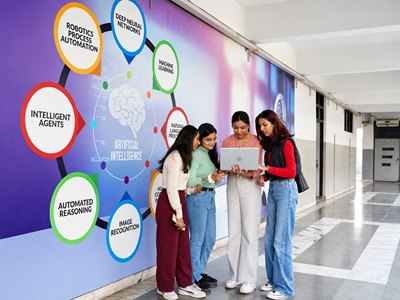
Growing preference for employability, industry integration, global exposure and future-ready careers reflects changing higher education aspirations across India
Mumbai / Faridabad : India’s higher education landscape is witnessing a significant shift as students increasingly prioritise employability, industry relevance and future-ready skills over conventional degree choices. Emerging disciplines such as Artificial Intelligence, Cyber Security, Data Science, Psychology and interdisciplinary programmes are witnessing strong growth in demand during the ongoing admissions cycle at Manav Rachna Educational Institutions.
Participation trends emerging from MRNAT 2026, conducted across more than 30 centres nationwide, indicate growing student preference towards career-oriented and industry-integrated academic pathways. Students from North, East, West, Central, South and North-East India, including Tier-2 and Tier-3 cities such as Guwahati, Ranchi, Siliguri, Imphal, Aizawl, Dimapur, Darbhanga and Vijayawada, actively participated in the admission process, reflecting rising awareness around emerging careers, technology-led education and evolving academic pathways.
Among the programmes witnessing the highest traction this year are B.Tech Computer Science Engineering with AI & ML, Generative AI in collaboration with Google Cloud, Data Science with Microsoft, Cyber Security & Threat Intelligence, Robotics & Artificial Intelligence, Quantum Computing and Cloud Computing. Strong student interest has also emerged in Psychology and Clinical Psychology, Design programmes, BBA in Data Analytics & AI, FinTech, Business Analytics, Electric Vehicle Technology, Food Science & Technology, Nutrition & Dietetics and entrepreneurship-linked programmes.
The growing momentum around these disciplines reflects how students are increasingly aligning academic decisions with evolving job markets, technological disruption and global industry transformation. Areas such as AI, semiconductor technologies, automation, digital business and mental health studies are emerging as some of the most aspirational career domains among young learners today.
Commenting on the changing higher education landscape and student aspirations, Dr. Prashant Bhalla, President, Manav Rachna Educational Institutions, said, “Students today are making education choices with far greater clarity and awareness. They are looking at employability, global exposure, innovation, entrepreneurship and the ability to build meaningful careers. This shift places a larger responsibility on universities to create academic ecosystems that connect classroom learning with industry needs, emerging technologies and real-world problem solving.”
Industry collaborations with organisations including Microsoft, Google Cloud, HCL GUVI, CDAC, Xebia, Deloitte, Cisco, Intel, L&T EduTech, Quick Heal, Mitsubishi Electric and Truechip are also contributing to growing student interest towards programmes that combine classroom learning with certifications, live projects, emerging technologies and industry engagement.
Another notable trend observed this year is the visible rise in female participation across STEM and interdisciplinary domains. Programmes related to AI, Data Science, Biotechnology, healthcare-tech, Psychology and Design-Tech are witnessing increasing interest from female students, reflecting broader national momentum towards innovation-driven and technology-enabled careers.
Highlighting the changing nature of academic learning and student preparedness, Dr. Sanjay Srivastava, Vice Chancellor, Manav Rachna International Institute of Research & Studies (MRIIRS), said, “The future of education will be shaped by how effectively institutions integrate interdisciplinary learning, research orientation, experiential pedagogy and problem-solving into the student journey. Learners today are seeking academic environments that encourage innovation, collaboration, critical thinking and real-world application. Universities therefore need to continuously evolve learning ecosystems to prepare students for rapidly changing technological and societal realities.”
Students and parents are also increasingly evaluating institutions on factors such as placements, industry exposure, global academic pathways, certifications, internships and return on investment, rather than relying solely on traditional reputation markers. This reflects a larger transformation in student aspirations, where career outcomes, flexibility and real-world learning are becoming central to higher education choices.
As part of this effort to support students make more informed higher education decisions, Manav Rachna is organising the Admissions Expo 2026 on May 23, Saturday at the campus, where students and parents can explore programmes, career pathways, scholarships, psychometric profiling and global opportunities.
Commenting on changing student and parent expectations during the admissions cycle, Prof. (Dr.) Deependra Kumar Jha, Vice Chancellor, Manav Rachna University, said, “Students today are spending far more time understanding courses, specialisations and career pathways before making admission decisions. Parents are equally evaluating factors such as internships, industry exposure, global opportunities, flexibility and long-term career growth while selecting institutions. This reflects a much more aware and research-driven approach towards higher education choices across the country.”
Manav Rachna’s collaborations with international institutions including KEDGE Business School, Monash University, HTMi Switzerland and NABA Italy continue to strengthen globally aligned academic pathways for students. Institutional strengths including QS World University Rankings 2026 recognition, NAAC A++ accreditation, presence in the NIRF Top 100 Universities list for two consecutive years, growing industry participation in campus hiring across sectors and a strong focus on innovation and entrepreneurship through 110+ supported ventures continue to support its industry-aligned academic ecosystem.



Leave a Reply