
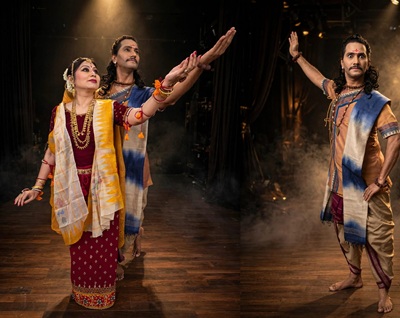
Mumbai: Marking a monumental milestone in India’s cultural landscape, Shahana (Tagore Centre for Indian Music and Culture) brought its Golden Jubilee year to a magnificent close at a packed Veer Savarkar Auditorium, Dadar. The 51st-anniversary finale unfolded as an absolute triumph, leaving a housefull audience spellbound through an exquisite confluence of classical dance, evocative theatre, soul-stirring music, and timeless poetry.
The evening’s crown jewel was the much-anticipated staging of Rajendranandini – The Warrior Princess, a contemporary and intellectually gripping adaptation of Rabindranath Tagore’s classic dance drama Chitrangada.
At the helm was acclaimed choreographer and director Anusree Bonnerjee, Honorary Creative Head of Shahana, whose visionary direction transformed the stage into a canvas of profound artistic storytelling. Her meticulous spatial arrangements, sensitive handling of character arcs, and seamless blending of Manipuri, Bharatanatyam and Rabindrik idioms brilliantly highlighted enduring themes of gender equality, inner beauty, and the formidable strength of womanhood.
Reflecting on her lifelong connection with the work, Bonnerjee said: “From the time I was a little girl, Chitrangada has always inspired me — especially the character Tagore called Kurupa, the warrior. For me, this whole sense of equality of genders and how Tagore spoke about societal pressures — that inner beauty is much more important than outer beauty, that outer beauty will wane — has stayed with me. I have done this dance drama many times directed by others, often as Shurupa, the beautiful woman. But the stronger character is the woman of substance. That is captured in the last song, ‘Ami Chitrangada, Rajendranandini… Nahi Devi, Nahi Samanya Nari’ — I am not a Devi for you to put on a pedestal, nor am I a Samanya Nari. I am somebody who, if you keep me by your side in goodness and in bad times, I’ll be there with you forever. These are relevant messages Tagore gave so many years back, which are relevant even today. For me in Shahana, it was important to bring in narration so people understand — Tagore is not only for Bengalis, Tagore is for India and to the world.”
Complementing her vision was an ensemble who delivered career-defining performances.
Esteemed Manipuri exponent Purbita Mukherjee as Chitrangada captivated with ethereal grace, razor-sharp technique and deeply emotional abhinaya.
Sharing her inner journey, Purbita said: “As a beautiful Chitrangada or Shurupa, I had a very beautiful experience. But to begin with, I don’t think that Shurupa and Kurupa are separate. It’s only the body beauty. But as soon as she was transformed, she realized that was not her true self. Her inner self was the first Prathama Chitrangada, which is Kurupa. So though she was transformed, it was only her outer beauty. Her inner self was the same. So she yearned for that old self, as did Arjun. We always look for outer looks, but it’s the inner beauty that everyone actually needs to introspect. That wins over the outside beauty.”
Meanwhile, Mumbai-based Bharatanatyam and Rabindrik Nritya exponent Anilkumar Singh stepped into the pivotal role of Arjun with commanding stage presence. Singh’s portrayal was nothing short of majestic — fierce yet vulnerable, regal yet introspective — delivering a strong, impactful performance that justified the multi-layered complexities of the mythological hero and earned prolonged thunderous applause and standing ovations.
Speaking about embodying Arjun, Singh shared: “Portraying Arjun in Rajendranandini was a deeply transformative experience for me as an artist. We often see Arjun as the invincible warrior, the hero of the Mahabharata. But here, Tagore shows us an Arjun who must unlearn. In the beginning, like most, he is captivated by Shurupa — the outer, ephemeral beauty. But it is Kurupa, the warrior Chitrangada in her true, unadorned form, who challenges his perception of strength and womanhood. For me, the most powerful moment was realizing that Arjun’s greatest victory was not on the battlefield, but within — when he learns to bow before inner beauty, courage and equality. Bringing that arc — from attraction to awe, from desire to deep respect — through Bharatanatyam and Rabindrik abhinaya was both challenging and liberating. I felt humbled to stand opposite such powerful women on stage.”
The cultural feast continued with Alokdhara, a deeply moving thematic concert of Rabindra Sangeet dedicated as a loving tribute to Shahana’s pioneering founders — Indrani Acharya, Sunanda Majumdar, and Snigdha Basu. The musical journey explored the three cosmic manifestations of divine feminine energy: Creation, Preservation, and Regeneration.
Young and gifted Rabindra Sangeet artistes Shramana Chattopadhyay, Megh, and Palashi Ghosh delivered soaring, pitch-perfect renditions that touched the soul. Each musical segment was masterfully introduced through evocative poetry penned and recited by Upamanyu Bhattacharya, while the overarching musical direction by Arup Chowdhury wove a seamless auditory tapestry that unified the entire evening.
For over five decades, Shahana has stood as an uncompromising guardian of India’s classical heritage. This anniversary finale did not merely celebrate a numerical milestone; it reaffirmed the institution’s unwavering dedication to artistic excellence, collective spirit, and the timeless relevance of Tagore’s vision for a more equal and introspective world.






Leave a Reply