
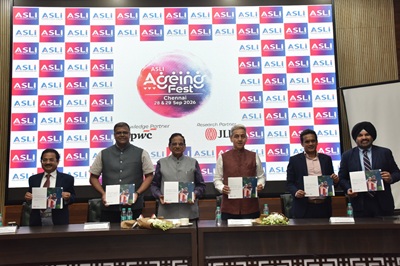
- India’s organised senior living stock comprises ~25,050 units as of June 2026, marking a significant expansion milestone and highlighting the growing need for quality senior care infrastructure.
- The addressable market of 1.7 million urban, financially independent senior households in 2026 is projected to grow to 2.1 million by 2030, creating demand across the wider senior care ecosystem.
- Organised senior living penetration stands at just 1.5%, dramatically lower than the 6-7% in the US and 14-15% in New Zealand, highlighting substantial growth potential.
- Assisted living remains particularly underdeveloped, with only around ~2,100 beds today against a projected requirement of ~11,000 by 2030.
- Well-managed facilities are achieving occupancy rates of 80-85%, demonstrating strong underlying demand for quality, trusted senior care solutions.
Mumbai/Delhi: India’s ageing transition is creating an opportunity that extends far beyond housing. According to the ASLI-JLL report, “India’s Silver Economy: From Niche to Necessity,” India’s senior living market could become a ~USD 10.1 billion opportunity by 2030, requiring USD ~7.7 billion in capital investment to meet new supply under a policy-driven scenario. The opportunity, however, extends well beyond senior living to encompass assisted care, healthcare, specialised care, rehabilitation and other services required to support India’s rapidly growing older population.
“India’s ageing transition is no longer a distant demographic story—it is unfolding before us. With over 166 million Indians aged 60+ today, a number projected to double by 2050, we need to build the ecosystem for ageing now. Yet organised senior living penetration remains at just 1.5%, pointing to the enormous headroom ahead. With changing family structures, rising incomes and evolving preferences, India’s senior living sector has the potential to become a ~USD 10.1 billion opportunity. The opportunity is about building a strong, accessible and trusted senior care ecosystem,” said Rajagopal G, Chairman, Association of Senior Living India (ASLI).
“We need to accelerate quality supply while giving much greater attention to assisted care, care financing, workforce development and the continuum of care. Realising this potential will require policy support, patient capital, specialist operators and innovative financial solutions working together. At ASLI, our priority is to help the sector scale responsibly, with quality, trust, choice and dignity at its centre. The ageing of India is inevitable; how well India ages is a choice we make today,” he added.
The organised senior living sector has reached 25,050 units as of June 2026, with market penetration at just 1.5%, compared with 6–7% in the United States and 14–15% in New Zealand. Growth is accelerating, with the sector recording a 14.2% CAGR between 2024 and H1 2026, compared with 8.5% during 2019–2023.
The demographic opportunity is equally significant. India’s 60+ population of 166.9 million is projected to reach 346 million by 2050. At the same time, the addressable market of urban, financially independent senior households is expected to grow from 1.7 million in 2026 to 2.1 million by 2030, creating significant demand for age-appropriate housing, care and support services.
“India’s senior living sector stands at a critical juncture, with 166.9 million seniors today growing to 346 million by 2050, we are looking at a market that could scale from ~25,050 units to ~74,000 units by 2030, unlocking ~USD 7.7 billion in capital deployment. But the real story is not just independent living, it is the assisted living crisis. We have barely ~2,100 assisted living beds today against a projected need of ~11,000 by 2030, while our 75-plus population is growing at 7.8% annually. The gap between demographic reality and infrastructure supply has never been starker. What transforms this from a real estate opportunity into a ~USD 10.1 billion market is policy intervention—states like Maharashtra and Haryana have shown the blueprint, and if replicated nationally with GST rationalization and regulatory clarity, we could triple market penetration from 1.5% to nearly 24% within four years. This isn’t incremental growth, it is a fundamental repositioning of how India cares for its aging population,” said Karan Singh Sodi, Senior Managing Director, JLL.
Assisted living remains one of the most significant gaps in the organised senior care ecosystem. With only 2,100 beds today against a projected ~11,000 by 2030, the segment remains critically underbuilt. The gap becomes more pressing as India’s 75+ population grows at 7.8% CAGR, increasing demand for higher-acuity and specialised care. Rental-based assisted living models can also offer greater affordability than ownership, creating an opportunity to expand access beyond conventional senior living models.



Leave a Reply