
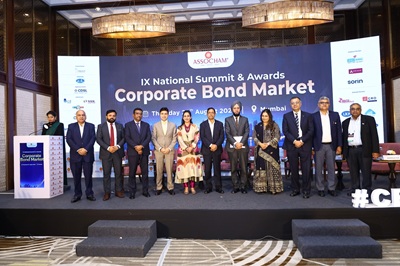
- Ashish Jaiswal underscores the need for a strong corporate bond market alongside a strong banking system to finance India’s next phase of growth
- ASSOCHAM-NSE Knowledge Report highlights the need for deeper liquidity, wider investor participation, technology-led innovation and stronger market infrastructure
- Industry leaders call for greater retail participation, improved secondary market liquidity and technology-enabled access to strengthen India’s corporate bond ecosystem
Mumbai: India needs a deeper, more resilient and diversified corporate bond market to strengthen long-term capital formation, broaden investor participation and support the financing requirements of infrastructure and sustainable development, deliberated policymakers, financial institutions, market participants and industry stakeholders at the 9th National Summit & Awards on Corporate Bond Market, organised by ASSOCHAM under the theme “Building a Resilient Corporate Bond Market: A Key Enabler of Viksit Bharat@2047.”
The summit brought together key stakeholders from across the financial ecosystem to deliberate on strengthening the corporate bond market, expanding the investor base, leveraging technology and global connectivity, and scaling bond-based financing for infrastructure and sustainable development.
Advocate Ashish Jaiswal, Hon’ble Minister of State for Finance, Planning, Agriculture, Relief & Rehabilitation, Law & Judiciary and Labour, Government of Maharashtra, said, “As India moves towards becoming a developed nation, a strong corporate bond market will be as important as a strong banking system and financial long-term growth. A strong corporate bond market will be instrumental in financing India’s next phase of growth. As we move towards Viksit Bharat 2047, our collective focus should be deepening the debt market and broadening investor participation.” He highlighted the
financing requirements of Maharashtra’s rapidly growing cities, including Mumbai, Pune, Nagpur, Nashik and Thane, particularly for public transport, water supply, affordable housing, waste management and climate-resilient infrastructure. He said municipal bonds could become an important source of financing for urban local bodies by reducing pressure on public finances. “Maharashtra remains committed for supporting reforms that strengthen capital markets, improve access to long-term finance and accelerate inclusion of infrastructure-led growth,” he added.
Mr. K. Rajaraman, Chairperson, International Financial Services Centres Authority (IFSCA) said, “We aim to work with stakeholders to bring down the cost of doing business and improve the ease of doing business. We will work together to ensure that the bond market becomes sufficiently capable of meeting the requirements that India will face as we move towards the 2047 agenda. Through the collective efforts of regulators, industry associations, issuers, investors, exchanges, intermediaries and policymakers, we can build a stronger bond market capable of financing India’s 2047 journey.”
Mr. Amarjeet Singh, Whole Time Member, Securities and Exchange Board of India (SEBI), said, “Our objective is to build a corporate bond market that is deeper, more liquid, diversified, accessible and, most importantly, trusted. Achieving this will require continued collaboration among regulators, investors and intermediaries. SEBI will continue to engage with market participants through consultations and issuer outreach to help build a corporate bond market equal to the scale of our country’s ambitions.”
Ms. Nipa Sheth, Chairperson, ASSOCHAM National Council for Corporate Bond Market and Founder & Director, Trust Group, said, “In this transformative journey, a deep, liquid and efficient corporate bond market will play a pivotal role by mobilising long-term capital, diversifying funding resources and supporting the financial needs of India’s rapidly growing economy. In achieving this vision of Viksit Bharat 2047, the debt market will continue to be a key pillar for sustainable economic growth.”
She further noted that India’s outstanding bond market has grown significantly, while secondary market volumes remain relatively low. She highlighted the steps being taken by regulators, including digitisation, tokenisation and market-making initiatives, and said the summit would bring stakeholders together for meaningful discussions on the way forward.
Ms. Aditi Mittal, Co-Chairperson, Associate National Council for Corporate Bond Market and Director, AK Group, said, “In a debt market, we always consider consistency and steadiness as its strengths. Equity may have the glamour, but debt has the consistency. With the support of regulators, market infrastructure institutions and stakeholders across the ecosystem, I am sure these markets are here to stay.”
Mr. Vijay Chandok, MD & CEO, National Securities Depository Ltd. (NSDL), said, “A more mature economy will require of course a strong banking system but it will also require a deep bond market.” He said India’s aspiration of becoming a developed economy would require an unprecedented extent of long-term capital and highlighted liquidity, concentration, limited retail participation and fragmentation as key challenges facing the corporate bond market. He called for stronger secondary market liquidity and price discovery, a broader investor base, wider issuer participation and greater use of technology to build a more resilient bond market.
Mr. Nehal Vora, MD & CEO, Central Depository Services Ltd. (CDSL), said, “For an ordinary saver, for a retail investor, a bond is still harder to find, understand and buy than it needs to be. People want safety, some known source of income, diversification and ease of access. Debt, in my opinion, provides all four.” He highlighted the considerable headroom for expanding retail participation in corporate bonds, noting that while equity investing has become familiar to Indian households, corporate debt remains comparatively less visible and accessible. He emphasised the need to demystify bond investing and make it more understandable and effortless for ordinary investors, while improving transparency around liquidity and credit risks.
Mr. Rajkiran Rai G, Managing Director, National Bank for Financing Infrastructure and Development (NaBFID), said, “India is standing at a defining moment of its economic journey, and as we aspire to become a US$30 trillion economy by 2047, infrastructure and CapEx will be important pillars supporting this transformation. Financing this huge requirement makes the bond market indispensable. Going forward, we need more patient and long-term capital, and the bond market is the route to bridge this gap and support India’s infrastructure ambitions.”
Mr. Krishnan Iyer, Head Issuer Relationships, National Stock Exchange of India Limited (NSE), said, “A deeper corporate bond market can complement bank financing and provide businesses with diversified avenues to raise capital. The journey towards a resilient bond market will require innovation, wider participation, deeper liquidity and collaboration across the ecosystem.” He highlighted the significant growth of India’s corporate bond market and the role of exchange infrastructure in strengthening capital raising, transparent price discovery and secondary market liquidity. He also pointed to the growing adoption of online bond platforms, which are enabling wider participation from retail investors and making bonds more accessible beyond traditional institutional participation.
The summit also marked the release of the ASSOCHAM-NSE Ltd. Knowledge Report, providing insights into the corporate bond market and the measures required to strengthen its resilience and deepen participation.
The deliberations reaffirmed the importance of building a deeper and more resilient corporate bond market through stronger market infrastructure, wider investor participation, technology-led innovation and greater integration with global financial markets. Stakeholders highlighted the need to strengthen the role of bond markets in mobilising long-term capital for infrastructure, sustainable development and the broader objectives of Viksit Bharat@2047.






Leave a Reply