
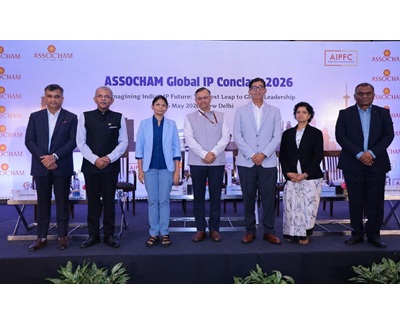
New Delhi : “India’s intellectual property ecosystem is rapidly evolving, marked by a sharp rise in domestic innovation even as new-age technologies introduce complex risks. With 69% of filings now originating from Indian entities, the country is strengthening its innovation backbone “, said Prof. (Dr.) Unnat P. Pandit, Controller General of Patents, Designs and Trademarks , at the ASSOCHAM Global IP Conclave (AGIPC) 2026 in New Delhi.
Highlighting the scale of India’s transformation, Dr. Pandit noted that the country recorded over 1.43 lakh patent applications this year, reflecting a 30% growth, alongside a 146% increase in filings over the last five years, signalling a shift from incremental growth to global IP leadership. Complementing this, Ms. Jaiswal emphasized that digital trade contributes nearly 25% to India’s GDP, making the protection of intangible assets in an AI-driven economy increasingly critical.
However, as artificial intelligence accelerates innovation, it is also creating unforeseen intellectual property challenges. AI models may inadvertently trigger copyright and trademark violations due to the nature of data they are trained on, cautioned Ms. Padma Jaiswal, IAS, Secretary, Government of NCT of Delhi , underscoring the urgent need for awareness and stronger safeguards in the digital ecosystem.
Mr. Vinamra Mishra, Joint Secretary, Ministry of MSME, Government of India, highlighted during his special address saying, “ India’s innovation ecosystem is at an inflection point, with the country now ranked among the top 30 in the Global Innovation Index and IP filings witnessing consistent double-digit growth. The priority ahead is to ensure commercialization of these IP assets, particularly for MSMEs, which contribute nearly 45% to exports and will be key to driving innovation-led growth .”
The conclave, themed “Reimagining India’s IP Future: The Next Leap to Global Leadership,” brought together policymakers, industry leaders, global experts, and academia to deliberate on strengthening India’s IP ecosystem amid rapid technological transformation.
The conclave further explored key themes across two high-impact thematic sessions. The first session, “From Innovation to Prosperity: Strengthening Economies through IP,” brought global perspectives on how IP frameworks can drive economic growth, enhance commercialization, and strengthen international collaboration.
The second session, “Frontiers of Innovation: Navigating IP in Emerging Technologies,” examined challenges and opportunities in emerging domains such as artificial intelligence, biotechnology, and deep tech, with discussions focusing on ownership complexities, regulatory gaps, and strategies for future-ready IP frameworks.
Throughout the discussions, speakers emphasized the importance of aligning policy, industry, and academia to build a robust IP ecosystem that not only fosters innovation but also translates ideas into scalable and commercially viable solutions.
The ASSOCHAM Global IP Conclave 2026 reinforced India’s growing stature as a global innovation hub and highlighted the collective commitment of stakeholders to drive the country’s next phase of growth through a strong, inclusive, and forward-looking intellectual property ecosystem.



Leave a Reply