
Mumbai/Kolkata: The future of surgery took centre stage as Manipal Hospitals Kolkata unveiled a glimpse of tomorrow’s healthcare through an exclusive Robotic Simulation Workshop today. Bringing together some of the brightest minds in medicine, technology, and academia, the event offered an immersive experience into the world of robotic-assisted surgery, showcasing how innovation, precision, and human expertise are converging to transform patient care. Under the theme “The Future is Here – with Robotic Surgery at Manipal Hospitals,” the workshop highlighted the next era of surgical excellence, where advanced robotics is enabling surgeons to perform complex procedures with greater accuracy, enhanced control, and improved outcomes across multiple specialties.
The programme commenced with a welcome address by Dr. Ayanabh Debgupta, Regional Director, Manipal Hospitals East, followed by the felicitation of the Chief Guest and Special Guest. The event was graced by Prof. (Dr.) Dilip Kumar Pratihar, PhD (IITK), FNAE, FIE, SMIEEE, MASME, AvH Fellow, Professor and Head, Mechanical Engineering Department, IIT Kharagpur, as the Chief Guest and Prof. (Dr.) Sushmita Mitra, PhD (ISI, Calcutta), FIEEE, FTWAS, FNA, FNAE, FNASc, as the Special Guest.
Speaking on the clinical applications of robotic technology, Dr. Kunal Sarkar, Director – Cardiovascular & Thoracic Surgery, Manipal Hospital, Mukundapur Cluster, addressed the role of robotics in Cardiothoracic and Vascular Surgery (CTVS) and General Surgery, while Dr. Sourav Datta, Director – Manipal Comprehensive Cancer Care, Manipal Hospitals – Mukundapur, Salt Lake & Siliguri Clusters, highlighted advancements in robotic-assisted oncology surgery. The sessions further explored the impact of robotics in Orthopaedics by Dr. Vikas Kapoor, Cluster Director – Orthopaedics, Manipal Hospitals Mukundapur Cluster, Urology and Uro-oncology by Dr. Abhaya Kumar, Director – Urology and Uro-Oncology, Manipal Hospital EM Bypass and Senior Consultant – Urology, Manipal Hospital Mukundapur, Broadway and Salt Lake and Gynaecology by Dr. Arunava Roy, HOD – Gynaecologic Oncology – Manipal Hospital EM Bypass and Senior Consultant – Gynaecologic Oncology, Broadway and Salt Lake.
The programme also witnessed the introduction of the new team of robotic surgeons at the Manipal Hospitals Salt Lake Cluster, featuring leading specialists including Dr. Debkumar Ray, Senior Consultant – Gastrointestinal Surgical, Manipal Hospital Broadway; Dr. Abhinibesh Chatterjee, Senior Consultant – Obstetrics and Gynaecology, Manipal Hospital Salt Lake; Dr. Abhishek Bhaumik, Consultant – Advanced Laparoscopic Surgeon, Manipal Hospital Broadway; Dr. Polly Chatterjee, Senior Consultant – Obstetrics & Gynaecology; Dr. Arijit Singha Mahapatra, Consultant – Surgical Gastroenterology, Manipal Hospital Broadway and Dr. Sujoy Chatterjee, Head of the Department – Cardiothoracic and Vascular Surgery, Manipal Hospital Broadway, who will spearhead advanced robotic-assisted surgical care across multiple specialties.
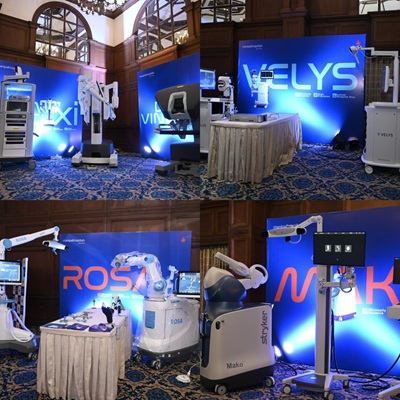
During his session, Prof. (Dr.) Dilip Kumar Pratihar, shared, said, “The integration of robotics and advanced technologies is revolutionising the field of medical science by enhancing precision, efficiency, and patient outcomes. During my interaction with the doctors, I gained valuable insights into how robotic systems like Velys, Da Vinci Xi, ROSA, and Mako are being utilised across surgical specialties to assist surgeons with greater accuracy and improved clinical decision-making. These advancements reflect the growing synergy between engineering and healthcare, where innovation is enabling more personalised, minimally invasive, and effective treatments for patients.”
In her address, Prof. (Dr.) Sushmita Mitra, stated, “”The future of healthcare lies in the seamless collaboration between medicine and technology. AI and robotics are not here to replace clinicians, but to empower them with greater precision, improved clinical outcomes, and faster patient recovery. As these technologies continue to evolve, they must always be guided by ethics, compassion, and human judgment to truly serve humanity. I commend Manipal Hospitals for creating a platform that brings together medical professionals, engineers, scientists, and technology experts to exchange knowledge and foster interdisciplinary collaboration. The future of healthcare will be shaped by those who combine clinical excellence with technological innovation, ultimately delivering safer, smarter, and more patient-centric care.”
A special highlight of the event was the Robotic Simulation Lab, unveiled by the Chief Guest and Special Guest, The guests and participants explored the robotic systems available at the lab, including Mako, Velys, ROSA, and Da Vinci Xi. In orthopaedics, Mako (Stryker), Velys (DePuy Synthes), and ROSA (Zimmer Biomet) are transforming joint replacement procedures by enabling greater surgical precision, personalised planning, and accurate implant positioning. The Da Vinci Xi robotic system supports advanced minimally invasive surgeries across multiple specialties, enhancing surgeon control and patient outcomes. The demonstration showcased how robotics is driving the evolution of medical science by making procedures more precise, efficient, and patient-centric.
Speaking about the growing adoption of robotic-assisted oncology procedures, Dr Sourav Datta, said, “Robotic technology is transforming cancer surgery by enabling greater precision and control during complex procedures. It has improved surgical accuracy in difficult-to-access tumours while helping reduce blood loss, post-operative pain, and recovery time. With advanced robotic systems and multidisciplinary expertise, we are focused on delivering safer surgeries and better outcomes for cancer patients.”
Highlighting the impact of robotics in orthopaedics, Dr Vikash Kapoor, said, “Robotic-assisted orthopaedic surgery has brought a new level of precision and personalisation to joint replacement procedures. With improved implant positioning and surgical planning, patients benefit from reduced pain, faster rehabilitation, and better mobility outcomes. Having performed over 1,500 robotic knee replacement surgeries at Manipal Hospitals EM Bypass in two years, we continue to witness the growing impact of technology-driven orthopaedic care.”
While discussing the role of robotics in gynaecological procedures, Dr. Abhinibesh Chatterjee, said, “Robotic-assisted surgery is transforming gynaecological care by enabling surgeons to perform complex procedures with greater precision, enhanced visualisation, and improved control. With minimally invasive techniques, robotics helps reduce surgical trauma, support faster recovery, and deliver personalised treatment approaches, improving overall patient outcomes and experiences.”
The workshop provided participants with an immersive understanding of robotic surgery through live demonstrations, expert interactions, and hands-on simulation experiences, highlighting the precision, accuracy, and possibilities offered by next-generation surgical technology. Through this initiative, Manipal Hospitals reaffirmed its commitment to bringing advanced medical innovation closer to patients and strengthening the future of precision-based surgical care.





Leave a Reply